2026-10-04 Reverse Engineering Jane Street’s ASIC Puzzle
An attempt at quantlarping in the year of our lord 2026
This year Jane Street decided to do an ASIC reverse engineering challenge, which i find interesting as hardware has been something i’ve been trying to get into lately. I thought i’d have more time to go on sidequests like this as last year i was bogged down by work, but unfortunately this year i also find myself bogged down by midterms at my postgrad work in NTU. Alas i find myself reading at some of the solutions made by people smarter than me, which got me wanting to try some of the work myself to see if there were any stones unturned (also to do a quantlarping blogpost lol).
The README’s layout.png labels the pins (clk, rst_n, enable, I on the left, O[7:0] and success on the right) and boxes off an “output generator” that you’re told to ignore at first. So the chip takes one bit at a time and answers on a byte-wide bus. Opening example_inputs.vcd in a waveform viewer shows the protocol. rst_n is held low for three rising clock edges. Then enable goes high for exactly 121 cycles while I wiggles, drops, and does the same again for a second attempt of 121 bits. 121 is 11², so something is reading an 11×11 grid one square at a time. Shown as ASCII, O spells TRY AGAIN after each attempt.
The GDSII file format is a flat stream of records. Each one starts with a 2-byte length, a record type and a data type, followed by big-endian integers, ASCII, or 8-byte floats in IBM’s old excess-64 format.
def _real8(b):
    sign = -1 if b[0] & 0x80 else 1
    exp = (b[0] & 0x7F) - 64
    mant = int.from_bytes(b[1:], 'big') / (1 << 56)
    return sign * mant * 16.0 ** exp
The first pass found 81 cell definitions and one top cell, puzzle, with 9,875 references, 1,499 polygons, 7,061 paths and 17 text labels. Standard-cell names survived (sky130_fd_sc_hd__dfrtp_2, sky130_fd_sc_hd__a221oi_2), and so did every cell’s own pin labels on layer 67/5. Instance and net names were gone. Two cell names weren’t sky130 at all, INTERNAL_3 and INTERNAL_7, each one rectangle on layer 200. Those went on the oddities list straight away. Every polygon edge is horizontal or vertical (zero diagonal edges), and every one of the 7,061 routing paths has exactly two points, so every wire is one rectangle. Getting that rectangle right took one fix. The paths use three end styles: 6,232 are type 2 (extended by half the width), 751 are type 0 (flush), and 78 are type 4, whose extensions are given explicitly by BGNEXTN and ENDEXTN records.
Polygons to nets
sky130 has one local interconnect layer and five metals. Each cut layer joins the conductor with the same layer number to the one above it:
| Conductor | GDS layer | Cut above it | Joins |
|---|---|---|---|
| li1 | 67/20, pin 67/16 | mcon 67/44 | li1 → met1 |
| met1 | 68/20 | via 68/44 | met1 → met2 |
| met2 | 69/20 | via2 69/44 | met2 → met3 |
| met3 | 70/20 | via3 70/44 | met3 → met4 |
| met4 | 71/20 | via4 71/44 | met4 → met5 |
| met5 | 72/20 | none |
Layer 66/44 (licon) is left out on purpose. It connects li1 down to polysilicon and diffusion inside a cell, which is transistor business, and including it would short every cell’s internals together.
The extractor does five things:
- Flatten every reference into die coordinates. Only four orientations occur: 8,881 R0, 546 mirrored, 233 R180 and 215 mirrored plus R180.
- Cut each Manhattan polygon into rectangles with horizontal slabs.
- Union every two rectangles on the same layer that touch or overlap, using a spatial hash with 3 µm buckets.
- For each cut, take its centre point and union every shape on layer L and L+1 that covers it.
- For each pin label inside a cell, find the shape under the label point on that layer, but only among shapes that belong to the same cell instance, so a label near a cell edge can’t pick up a neighbour’s shape.
for l, rects in cuts.items():                 # l = 67..71, datatype 44
    for r in rects:
        cx, cy = (r[0] + r[2]) // 2, (r[1] + r[3]) // 2
        lo = list(hits(l, cx, cy, cx, cy, False))       # shapes on layer l
        hi = list(hits(l + 1, cx, cy, cx, cy, False))   # shapes on layer l+1
        if lo and hi:
            for it in lo + hi: uf.union(lo[0][1], it[1])
        else:
            nocon += 1                        # a cut that lands on nothing
On the warm-up the extractor finds 79 logic cells with every pin on exactly one net, in 0.07 s. On the puzzle it finds 728 logic cells and 741 nets in 0.37 s, plus 676 tap, 204 decap and 10 diode cells with no logic. Zero cuts failed to land on both layers, and zero pins touched more than one net. One net has no driver at all (net 56476) which feeds input A1 of an a31oi and A1 of an a311o.
a221oi means AND groups of 2, 2 and 1 inputs, ORed together, then inverted. o32a means OR groups of 3 and 2, ANDed. The pins follow the groups: A1 A2, B1 B2, C1. So instead of loading the PDK’s Verilog models, cells.py generates every AND-OR and OR-AND function from the name, with a short table for the rest (inverters, buffers, XOR and XNOR, mux2, and AOI/OAI variants with one active-low input like a21boi). The puzzle uses 66 logic cell types, and the file is 59 lines. The plain gates with active-low inputs got me. The first version assumed the inverted pins always come first, as in and4bb (A_N, B_N, C, D), the variant the warm-up uses. The warm-up passed. The first puzzle simulation stopped with KeyError: 'A_N'. AND and NAND put the inverted pin first (and3b: A_N, B, C), while OR and NOR put it last (or3b: A, B, C_N). The fix was to read which inputs end in _N from the extracted pin names instead of guessing. Luke’s post describes a version of this bug that produced wrong logic silently. Mine crashed because pin names were dictionary keys, which is the better way for it to go wrong.
The flip-flops split the netlist into a combinational graph with no loops. A depth-first sort orders the 630 gates, one pass evaluates them, and then all 92 flops update together: 0 if RESET_B is low, 1 if SET_B is low, otherwise D. Each gate compiles to one inline truth-table lookup:
# a nand2_2 gate in the generated _eval(v). Bit m of 7 = 0b0111 is the output
# for input index m = A | B<<1, so only A = B = 1 gives 0.
v[69884] = (7 >> ((v.get(70528, 0) << 0) | (v.get(69889, 0) << 1))) & 1
That runs at about a third of a millisecond per clock cycle. My first version called a small model function per gate and built a dictionary of pin values for every call, and everything downstream took twice as long. Two checks before believing anything it says. The warm-up’s source is given, so its answer is known: for every a from 0 to 255 and b = 495−a, 496−a and 497−a, S equals a + b == 496. And replaying the puzzle VCD at all 312 rising edges reproduces O at every edge, including both TRY AGAINs, byte for byte. The thing is, my script printed only the last 12 cycles, all zero, and i kinda concluded O never left zero in the file.
Treating the chip as a black box
At this point we have a functional gate-level model of the chip but we have no idea what it does, Manually reading 630 gates is possible but will take forever, so instead we characterize the circuit using three standard simulation primitives: (1) apply input vectors and observe outputs, (2) force a flip-flop to a known value, and (3) trace the fan-in cone of each flip-flop.
We run the chip with a 121-bit all-zeros input vector and latch the final state of every flip-flop as the baseline. We then run 121 additional simulations, each driving a single 1 at square t (one-hot input vectors), and record the set of flip-flops whose final state differs from the baseline. Each flip-flop is thereby annotated with the set of input squares that perturb it (i.e. its observable input-dependence set.)
base = run(set())
touched = collections.defaultdict(set)
for t in range(121):
    q = run({t})
    for f in q:
        if q[f] != base[f]: touched[f].add(t)
| Flops | Disturbed by | First reading |
|---|---|---|
| 11 | one column each (squares 3, 14, 25, …) | a counter per column, so it is an 11×11 grid |
| 11 | irregular groups of 4 to 28 squares | a counter per region? |
| 1 | all 121 squares | bit 0 of a total count |
| 12 | one square each, the last 12 | a 12-deep memory of recent squares |
| 8 | 56 to 60 scattered squares | something mixing the whole input, inside the output generator |
The columns confirm the 11×11 guess. For the irregular groups, an exact tiling search finds that all 11 together cover the 121 squares with no overlap, so the board is divided into 11 regions.
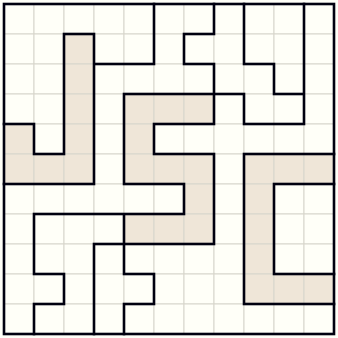
In row-major order, the squares that touch square t and appear earlier in the stream are t−1, t−10, t−11 and t−12, so a 12-element lookback exactly covers the backward neighbourhood. A board with a single star leaves that row holding one star, while the all-zero run leaves every row with none. If the chip only checks whether a row has the correct count, both cases are incorrect, and a flag recording “some row was wrong” is set either way. Which would explain why the probe can’t see rows.
To test this, I constructed a board with exactly two stars in every row, spaced so that no two touch (even rows use columns 0 and 2, odd rows 5 and 7), and compared it against variants in which row 4 alone holds 0, 1 or 3 stars. One flip-flop, 5638, differs between the all-two board and the all-zero board, but not between the all-zero board and any of the three row-4 variants. Varying row 4 alone:
| Stars in row 4, every other row 2 | Flop 5638 at the end |
|---|---|
| 0 | 1 |
| 1 | 1 |
| 2 | 0 |
| 3 | 1 |
| 4 | 1 |
So 5638 is a sticky “bad row” flag, and a row is good only with exactly two stars. The probe only shows the first bit of each column or region counter, since one star only ever moves the first bit. To find the second bit I used the netlist, but only to ask a structural question: which flop feeds this flop’s next-state logic and is fed by it in return? Each of the 22 counters has exactly one such partner. Then, putting k stars into column 3:
| Stars in column 3 | Counter bits |
|---|---|
| 0 | 00 |
| 1 | 10 |
| 2 | 01 |
| 3 | 11 |
| 4 | 11 |
A 2-bit counter that saturates at three. The regions count the same way. The total is a plain binary counter: across 0 to 36 non-touching stars, its bits always read the star count. Now I could force the answer out. I ran the two-per-row board, then overwrote every column and region counter and the total with chosen values before the final clock, and watched success:
| Forced state | success |
|---|---|
| every column and region at 2, total 22 | 1 |
| total 20, 21, 23 or 24 | 0 |
| one column at 0, 1 or 3+ | 0 |
| one region at 0, 1 or 3+ | 0 |
So every column and every region needs exactly two stars, and 22 in total, which is 11 rows × 2 and therefore redundant once the rows are right.
The solution
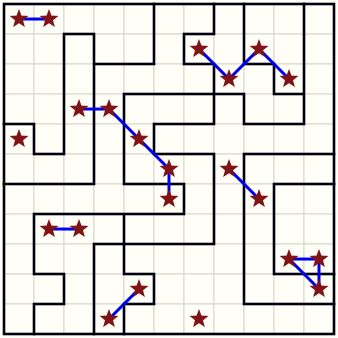
Last rule. The 12-square memory suggested neighbours matter, so I probed pairs: one star at square 60 (row 5, column 5) and a second star d squares later, for d from 1 to 24, looking for flops that pairs move but single stars never do. Three show up. Two of them (8591 and 1808) are second counter bits, which only move when two stars share a region or a column. The third, 5337, is set only at distances 1, 10, 11 and 12. Moving the first star to the board’s edges shows it knows where rows end:
| First star in | Second star sets 5337 at (row, column) offset |
|---|---|
| column 5 | (0, +1), (+1, −1), (+1, 0), (+1, +1) |
| column 0 | (0, +1), (+1, 0), (+1, +1) |
| column 10 | (+1, −1), (+1, 0) |
The solver operates on a fixed 2-per-row, 2-per-column, 2-per-region constraint set with an 8-neighbour (Moore neighbourhood, diagonals included) non-adjacency exclusion on star placement. Positions are indexed in stream order; for a star at index i, the four forward neighbours are checked against the four backward neighbours of the paired star at index j, such that the union of both sets spans all eight surrounding cells. Adjacency is defined topologically on the board lattice, not by stream proximity (e.g. cells 10 and 11 are stream-adjacent but edge-disjoint, and therefore not touching).
This defines the Star Battle (a.k.a. Two Not Touch) constraint satisfaction problem. The solver consumes only the rule set and the region map. It performs a DFS over the search tree, placing two stars per row in left-to-right order, and prunes a candidate cell if:
- its column already contains 2 stars,
- its region already contains 2 stars, or
- it lies within the Moore neighbourhood of a previously placed star. The search enumerates the full tree and yields exactly one valid solution.
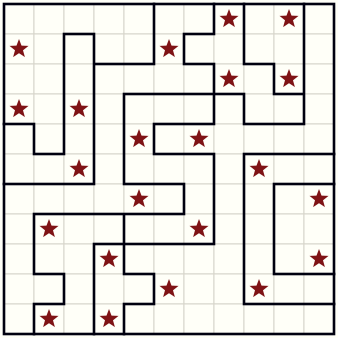
The first time I fed it in, my script said success = 0. I had read success immediately after the 121st clock edge. It goes high one clock later and stays high. For the negative case I flipped each of the 121 bits in turn, and all 121 runs print TRY AGAIN. The output generator then emits one byte per clock:
00 28 2a 20 54 57 4f 20 53 54 41 52 53 20 2a 29 00 00 00 00
    (  *     T  W  O     S  T  A  R  S     *  )
The answer is (* TWO STARS *). The (* *) around it is OCaml comment syntax. The puzzle page says there are easter eggs, Jane Street’s results post lists six intended ones plus a seventh that started life as a bug.1 I found five of the six intended ones on my own.
The waveform header
The leap second and “Leave no stone unturned!” were the first two entries on the list.
The night sky
This is the one I missed. Once you know the input is an 11×11 grid, the obvious thing is to draw the VCD’s two failed attempts as grids.
..#.#.#....      ##.#.##....
...#.##....      #..####....
#.#..##....      .....#.....
.....#.....      #....##....
.###.##....      ###.###....
#..#.##....      #....##....
###..##....      #..#.##....
...#.##....      ..#.###....
..#.###....      ##..###....
.....#.....      .....#.....
##..###....      .....#.....
The right four columns are empty in all 22 rows, which no real guess at a solution would do. Read the left seven columns of each row as a 7-bit number, least significant bit first, and every row is a printable character: the attempts spell “The night s” and “ky awaits”. I’d tried decoding the bit stream as ASCII earlier by cutting it into continuous 7- and 8-bit chunks, which runs straight across the row boundaries and finds nothing. The grid printout had the answer, and I looked right past it.
Morse code under the die
The two INTERNAL cells are placed 36 times in a single row at y = −52.72 µm, below the 200 × 300 µm die boundary on layer 235/4. Every placement sits a whole number of 460 nm steps from the first one, 460 nm being the width of a sky130 placement site.2 INTERNAL_3 is 1,380 nm wide, so 3 sites, and INTERNAL_7 is 4,140 nm, 9 sites. The gaps are 3 sites inside a group, 9 between groups and 21 in three places. A 1:3 ratio between short and long marks, with gaps of 1, 3 and 7 units, is standard Morse timing.3 Here everything is scaled by three.

It reads PER ARENAM AD ASTRA, “through sand to the stars”, a play on per aspera ad astra. Chips are made from sand, and this one is about stars.
A logo in met2
The 1,366 met2 polygons are all 300 × 300 nm squares on a 57 × 57 grid with 300 nm pitch, starting at (34.9, 35.2) µm. A version-10 QR code is exactly 57 modules square,4 so my first guess was a QR code. zbarimg wasn’t installed either, so I printed the grid as text instead:

It’s the Jane Street logo. The warm-up GDS has the identical bitmap at (65.9, 66.2) µm. While in the GDS I also checked whether any standard cell had been tampered with, by comparing each cell definition against the same cell in the warm-up GDS. 21 came back different, which was exciting for about a minute (nothing special came of it tho).
Five messages
Once the rules were known, the natural thing was to ask the chip what it says about inputs that are wrong in specific ways. All zeros prints EMPTY SKY. All ones prints BIG BANG. A board with the right counts everywhere but touching stars prints TWO"NOT TOUCH, the puzzle’s other name, with a stray character in it. Finding that board took two tries: the solver with its touching check removed was still running after two minutes when I killed it, and adding one prune (no region may need more stars than it has squares left below the current row) made it return instantly. Six random boards for every star count from 0 to 121 confirmed that only 0 stars gives EMPTY SKY and only 121 gives BIG BANG.
To check there was nothing else, I went into the output generator. The eight flops that mixed the whole input turned out to be a key. Forcing them to all 256 values on the all-zero run printed EMPTY SKY every time. On the winning run it gave 256 different strings, so the key encrypts the winning message and nothing else. Walking back from O[7:0] finds 23 flops: those 8 and 15 more. 2¹⁵ is 32,768, small enough to try every state and read O once for each. The letters that can appear include C, H and U, which only TWO NOT TOUCH uses, and nothing points to a sixth message. Along the way I misread which of two flops was the success flag and decoded the star counter with two bits swapped, neither of which changed the result.
| Condition at the end of the input | O prints |
|---|---|
| 0 stars | EMPTY SKY |
| 121 stars | BIG BANG |
| all checks pass | (* TWO STARS *), decrypted with the board’s key |
| counts right, stars touch | TWO"NOT TOUCH |
| anything else | TRY AGAIN |
The floating wire
That stray " in TWO"NOT TOUCH is byte 0x22, one bit away from a space (0x20). It comes from the undriven net on the oddities list. My simulator treats an undriven net as 0. Tied to 1 instead, the message comes out as TWO NOT TOUCJ followed by two junk bytes, so neither value gives a clean string. The results post explains it: the floating wire was a real layout bug, caught during verification and left in on purpose.
I’d tested that net early on, tied both ways, and seen no difference. But I’d only tested it on the winning board. The net sits in a part of the output generator that only TWO NOT TOUCH uses, so on the winning board it does nothing. “No difference on the path I happened to look at” became “no difference” in my notes, and I spent a while calling 0x22 unexplained before finding out where it came from.
Jane Street, Results from the ASIC puzzle. It also links a long list of other writeups. Alejandro Soto Franco’s traces the floating wire the same way, and Gabriel Taboada’s and Aaron Shi’s decode the night sky message. ↩︎
The
unithdsite in sky130_fd_sc_hd is 0.46 × 2.72 µm. The warm-up’s DEF shows it directly: everyROWsteps by 460 and the rows are 2,720 apart. ↩︎ITU-R Recommendation M.1677-1, International Morse code: a dash is three dots, the space inside a character is one dot, between letters three dots, and between words seven dots. ↩︎
A QR code of version v is 17 + 4v modules on a side, so version 10 is 57. ↩︎